
Intersections: Strengthening Hate Crime Reporting and the Jabara-Heyer NO HATE Act
Published 4/28/2021 · 0 Comments
Our Intersections series looks at issues that haven't usually been labeled LGBTQ+ concerns. These topics touch everyone, yet LGBTQ+ people often face them at higher rates. Browse the full set of topics on our blog.
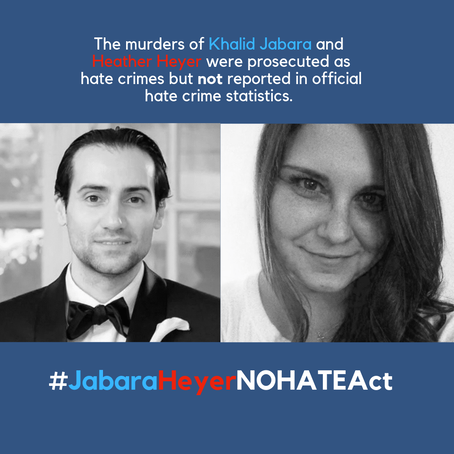
NEAT Supports the Khalid Jabara and Heather Heyer NO HATE Act
NEAT is proud to join the coalition of organizations that called on Congress to back the Jabara-Heyer NO HATE Act of 2021. If enacted, the bill would reshape how hate crimes are reported and how data is collected. Specifically, it would:
- Strengthen hate crime reporting by funding rollout and training for the National Incident-Based Reporting System (NIBRS), the newest crime reporting standard;
- Assist law enforcement agencies that adopt policies for identifying, investigating and reporting hate crimes, train officers to recognize hate crimes, and build systems for collecting hate crime data;
- Fund state grants to operate hate crime hotlines, document hate crime information, and connect victims and witnesses with law enforcement and local support services; and
- Permit alternative sentencing so judges may require people convicted under federal hate crime laws to perform community service or take education focused on the community targeted by the crime.
The measure was introduced in the 116th Congress but stalled then. With new legislative leadership and a rise in hate crimes against AAPI and other minority communities, the Act is gaining fresh momentum. Its reintroduction has drawn bipartisan and bicameral support, as a press release from Republican Senator Jerry Moran (KS) shows.
Khalid Jabara and Heather Heyer
Khalid Jabara was killed in Tulsa, Oklahoma, in 2016 by a neighbor, and Heather Heyer was killed in Charlottesville, Virginia, in 2017 when a car was driven into a group of counter-protesters. Both high-profile cases were prosecuted locally as hate crimes, yet neither showed up in federal hate crime statistics. That troubling gap in the data led civil society to examine hate crime reporting across the United States more closely.
Hate Crimes and LGBTQ+ People
After Matthew Shepard was murdered in Wyoming in 1998, his parents, Judy and Dennis Shepard, became tireless advocates for treating crimes motivated by sexual orientation as hate crimes. In 2009, the Matthew Shepard and James Byrd Jr. Hate Crimes Prevention Act became law, named for the gay student and for a Black man killed by white supremacists in Texas that same year. The law expanded the definition of hate crimes to include gender, disability, gender identity and sexual orientation, and it removed jurisdictional barriers to prosecuting violence motivated by race and religion. Judy Shepard, a strong supporter of the NO HATE Act, points out that hate crime legislation can still be improved: “Everyone in this country must be made aware of, and educated on, the need to strengthen current hate crime laws and to pass additional legislation. Stopping the increase of hate speech, the rising number of hate crimes against all marginalized communities, and the constant rise of new hate groups must be a top priority in this country.”
0 Comments
Join the ConversationNEAT Helps Set Up Dozens of Senate Meetings for the Equality Act
Published 4/24/2021 · 0 Comments
It was a landmark week for equality: NEAT and our partners in the Freedom & Opportunity for All Coalition arranged for nearly 500 constituents to join 75 meetings with lawmakers from 38 states about the urgent need to pass the Equality Act. Participants showed the broad and deep public support for this legislation — transgender kids and their parents, faith leaders, conservatives and many others.
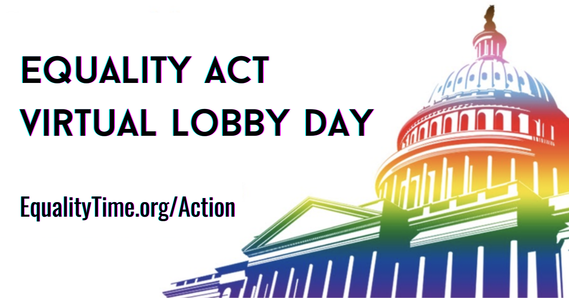
After Lobby Day, NEAT and the Human Rights Campaign invited attendees to a virtual follow-up event called “Drag, Debrief & Action,” featuring Drag Race, Broadway and musical star Peppermint. Attendees shared their Lobby Day experiences and took further steps to stay involved in the campaign. Peppermint thanked everyone for their tireless work and stressed how vital advocacy will be to passing the Equality Act.
“Arizona is one of a majority of states in the U.S. that lack LGBTQ nondiscrimination protections, which means people like me are vulnerable to being denied services or kicked out of public places just because of who we are,” said Kathy Young, a lesbian living in Arizona who was quoted in a press release about the event. “I was happy for the opportunity to participate in Lobby Day and tell my story in hopes of moving the Equality Act forward in Congress. As a parent, I worry every day that I might face discrimination and that it could hurt my ability to care for my family. Passing the Equality Act would allow me to feel safer and more respected when I am going about my life.”
The Equality Act would update federal civil rights law to guarantee clear, comprehensive protections for LGBTQ people against discrimination in nearly every area of life. The legislation passed the U.S. House of Representatives in a bipartisan victory and received a historic hearing in the Senate Judiciary Committee last month.
We still need your help to get this across the finish line! Sign up for a phone bank and make calls from home, or contact your Senator to voice your support for the Equality Act.
Sign Up for a Phone Bank Contact Your Senator0 Comments
Join the ConversationSpotlight of the Month: Hannah Kirkner (CA)
Published 4/18/2021 · 0 Comments
Spotlight celebrates the NEAT supporters who are the backbone of our everyday work for LGBTQ+ justice.
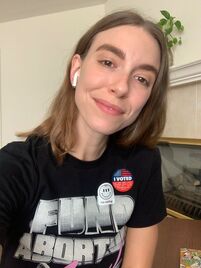
- NAME: Hannah Kirkner
- PRONOUNS: She/Her/Hers
- AGE: 29
- LOCATION: Los Angeles, CA
Tell us about yourself outside of volunteering with NEAT! (e.g. work, family, hobbies)
Outside of NEAT, I'm an avid reader who enjoys autobiographies, memoirs and historical non-fiction about social justice issues, feminism and the U.S. carceral system. I balance out my heavier reading with a steady rotation of reality TV, and I also enjoy cooking, working out and hanging out with friends. My day job is in the beauty industry, where I manage e-commerce for a skincare brand. I've worked in the fashion and beauty industry my entire career.
What's your connection to LGBTQ+ justice work?
I got involved in LGBTQ+ justice work in 2016 because I wanted to do more for the LGBTQ+ community. I believe it's important to use my cis-het privilege to advocate for change for my friends, so they can live their lives free of discrimination.
What is your volunteer role(s) at NEAT? What inspired you to get involved?
I'm a party host at NEAT, hosting phone banks weekly and providing training and support during volunteer shifts. I wanted to get involved in phone banking because it felt like a convenient way to help create change in communities across the country (and it is!).
Share a memory from volunteering that sticks out in your mind
The first campaign I worked on with NEAT was to pass a Human Rights Ordinance in Jacksonville, Florida. The HRO passed, which was an exciting moment. It felt good to help bring about positive legislative change.
What would you say to anyone considering volunteering with NEAT?
Do it! Phone banking is convenient, and anyone can get past their talking-on-the-phone jitters (Millennials — I get it!). There's also a wonderful community at NEAT; we'r
0 Comments
Join the ConversationExplore More

- April 2021 Archive
- September 2021 Archive
- August 2021 Archive
- July 2021 Archive
- June 2021 Archive
- May 2021 Archive
- April 2021 Archive
- March 2021 Archive
- February 2021 Archive
- January 2021 Archive
- October 2020 Archive
- August 2020 Archive
- July 2020 Archive
- June 2020 Archive
- May 2020 Archive
- April 2020 Archive
- March 2020 Archive
- February 2020 Archive
- January 2020 Archive
- December 2019 Archive
- November 2019 Archive
- October 2019 Archive
- August 2019 Archive
- All Categories
From hate crime reporting reform to Equality Act lobbying and volunteer spotlights, NEAT's blog tracks the work happening across the country. Browse the monthly archives to catch up on past campaigns, then join a phone bank or sign up for a house party to get involved.