
In December, Intersections discussed the Gee v. June Medical Services case pending before the Supreme Court of the United States, and how reproductive rights and related healthcare needs disproportionately affect the LGBTQ community. On Wednesday, March 4, 2020, oral arguments were heard in this case before the nation’s highest court.
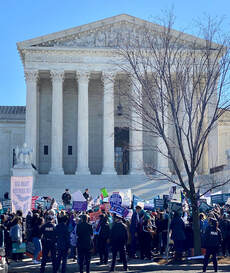
The Center for Reproductive Rights, who brought the case challenging the Louisiana abortion law, organized a large rally in front of the Supreme Court. NEAT was present and able to get a few photos of the rally in the slideshow below.
As a refresher, the case is centered on a Louisiana law requiring doctors who work out of healthcare centers providing abortions to also have admitting privileges at a local hospital (within 30 miles). This may sound generally reasonable, but in reality it’s an indirect way of closing healthcare facilities where abortions are available and skirting the legal principles established by the historical Roe v. Wade decision. Notably, the Supreme Court overturned an identical law by the State of Texas three years ago. Gee is a way for anti-abortion interests to test the new membership of the Supreme Court in an attempt to limit or overturn that recent decision.
The facts supporting the Louisiana case are slightly different than the Texas case, but the outcome of enacting the law would largely be the same: nearly all of the medical facilities where abortions are available as an option to patients would be required to close. The legislature and respondents claim the law is to protect patients who have complications that need emergency care, but there is little evidence that is a problem that needs to be addressed. Louisiana already has a low number of medical treatment facilities for its population and, in 2019, it was ranked one of the lowest states in the union for healthcare. Closing all of these clinics--which generally provide more than only access to abortions--would be a disaster. The Louisiana legislature would do well to focus on adding healthcare options for its citizenry instead of removing them.
People who watch the Supreme Court closely generally feel that the oral arguments held no surprises. The justices largely had questions based on their expected ideological viewpoints. Petitioner focused on the highest court’s long-standing practice of deferring to its previous decisions or “settled” law. The Trump Administration argued in support of the Louisiana law. Justice Alito focused on a technical aspect of the case--whether the clinic who challenged the law had a right to file the case, attempting to follow a constructed and misguided path that only women who are affected by the law could bring the legal challenge; other justices did not appear to engage in that discussion heavily. Most of the questions from the bench focused on what facts in these scenarios create an “undue burden,” which is a key component of the analysis of the Texas law that was overturned by the court more than three years ago. A decision regarding this Louisiana law is expected near the conclusion of the court’s term at the end of June 2020.
The Center for Reproductive Rights, who brought the case challenging the Louisiana abortion law, organized a large rally in front of the Supreme Court. NEAT was present and able to get a few photos of the rally in the slideshow below.
As a refresher, the case is centered on a Louisiana law requiring doctors who work out of healthcare centers providing abortions to also have admitting privileges at a local hospital (within 30 miles). This may sound generally reasonable, but in reality it’s an indirect way of closing healthcare facilities where abortions are available and skirting the legal principles established by the historical Roe v. Wade decision. Notably, the Supreme Court overturned an identical law by the State of Texas three years ago. Gee is a way for anti-abortion interests to test the new membership of the Supreme Court in an attempt to limit or overturn that recent decision.
The facts supporting the Louisiana case are slightly different than the Texas case, but the outcome of enacting the law would largely be the same: nearly all of the medical facilities where abortions are available as an option to patients would be required to close. The legislature and respondents claim the law is to protect patients who have complications that need emergency care, but there is little evidence that is a problem that needs to be addressed. Louisiana already has a low number of medical treatment facilities for its population and, in 2019, it was ranked one of the lowest states in the union for healthcare. Closing all of these clinics--which generally provide more than only access to abortions--would be a disaster. The Louisiana legislature would do well to focus on adding healthcare options for its citizenry instead of removing them.
People who watch the Supreme Court closely generally feel that the oral arguments held no surprises. The justices largely had questions based on their expected ideological viewpoints. Petitioner focused on the highest court’s long-standing practice of deferring to its previous decisions or “settled” law. The Trump Administration argued in support of the Louisiana law. Justice Alito focused on a technical aspect of the case--whether the clinic who challenged the law had a right to file the case, attempting to follow a constructed and misguided path that only women who are affected by the law could bring the legal challenge; other justices did not appear to engage in that discussion heavily. Most of the questions from the bench focused on what facts in these scenarios create an “undue burden,” which is a key component of the analysis of the Texas law that was overturned by the court more than three years ago. A decision regarding this Louisiana law is expected near the conclusion of the court’s term at the end of June 2020.
 RSS Feed
